Thursday, February 08, 2007

Dagga 'trees' cut down

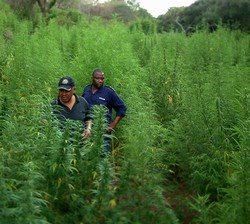
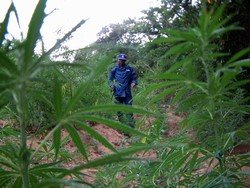
Ladysmith - Dagga smokers have been tossing their joint ends, and Nature has done its work, causing a massive growth in dagga bushes in and around the CBD.

SAPS area spokesperson, Captain Charmaine Struwig told the Witness that SAPS members had removed 7 321 dagga bushes valued at around R500 000, from vacant lots in between residential areas including Acaciavale, Lennoxville and areas adjacent to the CBD.

"They were more like trees, taller than our tall cops. The stems were 10 to 15cm in diameter. If we had not been using tree-poppers we would have been struggling," Struwig explained.

She said that the trees had not been deliberately cultivated, but were more likely the result of people discarding joints containing dagga seeds, speculating that dagga growers would have harvested the plants before they became so tall.

"There are a lot of vacant plots of land in Ladysmith in between residential areas which are densely overgrown. I mean, some of the weeds were as tall as the dagga trees," she said, adding that while Ladysmith had experienced "shoulder-high" dagga plants in previous years, this year had set records. The removed plants were all burnt, downwind of human settlements.

The SAPS would be monitoring the re-growth of the offending dagga plants, Struwig confirmed.

According to figures from a recently released South African Risk survey, in 2004 49% of teenagers used alcohol, 31% smoked and 13% used dagga regularly. The Witness

Monday, February 05, 2007

World's poor to be hardest hit by global warming: UN

The world's poor, who are the least responsible for global warming, will suffer the most from climate change, United Nations Secretary General Ban Ki-moon told environment ministers from around the world on Monday.

"The degradation of the global environment continues unabated ... and the effects of climate change are being felt across the globe," Ban said in a statement after last week's toughest warning yet that mankind is to blame for global warming.

In comments read on his behalf at the start of a major week-long gathering in the Kenyan capital, Nairobi, Ban said all countries would feel the adverse impact of climate change.

"But it is the poor, in Africa and developing small island states and elsewhere, who will suffer the most, even though they are the least responsible for global warming."

Experts say Africa is the lowest emitter of the greenhouse gases blamed for rising temperatures, but due to its poverty, under-development and geography, has the most to lose under dire predictions of wrenching change in weather patterns... Reuters

Thursday, January 25, 2007

110 Fires - 1000 people homeless

It appears it's as hot as Sodom here - homes burning - publicAdministrators living it up - Sodomising the cityzenry - children burning....

A total of 110 fires have raged across greater Cape Town in just 24 hours - leaving firefighters exhausted and fearing the worst with temperatures in the city set to reach a blistering 38°C on Thursday…

The City of Cape Town’s acting chief fire officer, Ian Schnetler, said this morning that the 110 fires had been recorded between midnight on Tuesday and midnight last night - 66 of them grass or bush fires.

‘Close to 1 000 people had been left homeless after fires destroyed 240 shacks’

“Some firefighters left the stations at 9am yesterday (Wednesday) and had still not returned after 8pm last night,” said Schnetler. “It’s hectic.”

At the last count, close to 1 000 people had been left homeless after fires destroyed 240 shacks.

Help was at hand on Thursday for 320 people stranded when a devastating blaze tore through an informal settlement off Pama Road in Khayelitsha on Thursday, destroying 120 homes…Cape Argus

Thursday, January 11, 2007

How to build an eco-house

What does it mean to be green? Not too many months ago I visited a village in the Western Cape that has an eco-friendly home under construction. It also had no geysers, no electricity, hardly any plumbing and less than half a roof. Made of cob, it was all very interesting, but I came away thinking there would be no cold beer at the end of the day.

The truly green house is not connected to any grid. It collects its own water and generates its own energy. It also disposes of its own waste. It may even be carbon neutral or positive, selling excess clean energy into the central grid.

But it would be exceedingly costly and difficult -- stupid even -- to attempt such a house at present in the South African urban environment.

City homes can aim to be sustainable, though, if they are designed to minimise both inputs and outputs. They can aim to maximise efficiencies so that running costs are low, as is waste output.

Sustainable homes aim to limit negative effects on the environment by using local and natural materials, recycled items and local products and services. They aim to be low maintenance and maximise energy efficiency by good orientation to the sun and using effective insulation...

Some websites offer online checklists where you can score your home in terms of how sustainable it is. But these are usually of limited value as what makes sense in Europe, for instance, is unlikely to be suitable for Johannesburg. In the north heating is the main thing, in the south cooling may be as, or more, important...

Cement
The house has used a lot of cement, a natural product with almost magical building properties, but one that takes vast amounts of electricity to produce. Along the way I found out that by-products of industrial processes, such as fly ash or slag, can be used as extenders, reducing the cement content in each bag by up to 34%.

All cement bags are labelled to reflect this, you just have to know how to decode the label.

There is also a lot of embodied energy in the steel used to make windows, doors and stairs and to support three slabs.

The house is nearing completion. It will harvest rainwater, recycle grey water (from the washing machine and showers, but not from the dishwasher), it will use natural gas for space heating and hot water, lighting will be low-wattage and where there are large sections of glass, safety glass will be used which has better insulation properties. It will have a closed firebox linked to water-based under floor heating. An outbuilding will have a sod roof.

In the United Kingdom the market for ethical goods and services, at £29-billion, now exceeds that for cigarettes and alcohol, according to a recent report.

In Cape Town there appears to be an active market in green building products and services. In Gauteng there is none.

I have learned from this project that if there is an eco-consciousness in this country it is in Cape Town.

As far as Gauteng is concerned, Noah's flood could be coming, we don't know it and we don't care. M&G Kevin's Ark


or read more below...

Tuesday, January 09, 2007

Driving Stoned vs. Driving Sober


Here’s an interesting video aired on British television that’s been gaining popularity online.

It’s not the most scientifically sound piece of research on the planet, but it does illustrate the point that maybe driving while stoned isn’t as dangerous as everyone makes it out to be. The consensus is that a healthy dose of paranoia after smoking generates increased concentration in the driver. On the flip side, driving while drunk makes your more liable to take risks.

Tuesday, December 19, 2006

Pot is called biggest cash crop

SACRAMENTO — For years, activists in the marijuana legalization movement have claimed that cannabis is America's biggest cash crop. Now they're citing government statistics to prove it.

A report released today by a marijuana public policy analyst contends that the market value of pot produced in the U.S. exceeds $35 billion — far more than the crop value of such heartland staples as corn, soybeans and hay, which are the top three legal cash crops.

California is responsible for more than a third of the cannabis harvest, with an estimated production of $13.8 billion that exceeds the value of the state's grapes, vegetables and hay combined — and marijuana is the top cash crop in a dozen states, the report states...

LA Times with video

Thursday, December 14, 2006

Smell of R2m dagga was a giveaway

Dagga worth about R2-million - concealed at the back of a truck believed to be owned by a Soweto man - has been discovered.

The 35-year-old driver, believed to be from Cape Town, was arrested by the Free State border police, but his accomplice fled the scene and is still on the run...

The Star

Leonardo Dicaprio - asks questions

I’m an actor, environmentalist and board member of Global Green USA and the NRDC. In 1998 I founded the Leonardo DiCaprio Foundation to foster awareness of environmental issues.

I'm becoming increasingly concerned that the impact of people on the planet is threatening our clean air to breathe, clean water to drink and the stable climate we live in... Yahoo! Answers

Sunday, December 10, 2006

Vagrant high veld turned into fragrant green zone

The Tshwane Metro Police are helping to reclaim a green area in Centurion for the birds, putting an end to the dagga-growing activities of local vagrants.

The Metro Police were alerted to the problem by Tshwane Nature Conservation that was recently granted control of the site. The area, on the corner of John Vorster and Nellmapius drives in Highveld, Centurion, is being transformed into a bird sanctuary called Findle Park.

Having long been a hide-out for vagrants, the situation turned dangerous when a group of 30 vagrants started stoning nature conservation workers tasked with clearing the area.

Tshwane nature conservationist Natalie Vos said they received complaints from their workers about the hostile vagrants. On further investigation the dagga plantation was found, which spanned more than a hectare. Pretoria News

Sunday, November 26, 2006

Swazi Gold set to ease growing poverty

A fundamental shift in Swaziland's attitude towards hemp, or dagga, the country's most lucrative cash crop, could be on the horizon.

The government is set to allow small-scale production of hemp to see if it has the potential to become an economically viable crop.

"In hemp we have an alternative to cotton, which has let us down badly over the past few years. It has been because of marijuana that we have found it difficult to talk about hemp, but that is changing, and we are beginning to shape public opinion to its benefits," said Lufto Dlamini, the Swazi Minister for Enterprise and Employment.

"The government is considering a proposal to grow hemp, and a decision will be reached by the end of this month. But I expect it will be given the go-ahead to grow for research purposes, and if that proves successful then we will see," he said.

'People are getting the idea that hemp can be used for purposes other than smoking'
Falling global prices for sugar and cotton, Swaziland's traditional crops, have led to dagga becoming "Swazi Gold" for many of the country's population, most of whom live on less than R7.20 a day.

According to the government's Annual Vulnerability Monitoring Report 2005, cotton prices have fallen steadily over the past few years as a result of international competition and last year's price for cotton was about 33 percent lower than the previous year.

A similar fate has befallen the sugar industry. The European Union plans to slash its price to suppliers in African, Caribbean and Pacific Least Developing Countries by 37 percent from the start of 2007 to bring it in line with the global price, causing the profits of Swazi producers to shrink significantly.

Dr Ben Dlamini, 70, a former education administrator in the Swazi Department of Education, was one of the first people to talk about the potential benefits of hemp production.

"The major emphasis on cannabis in Swaziland has always been on smoking it, but if we were to grow hemp commercially it would solve a lot of problems. It can be used to manufacture fuels, textiles, healthy oils and lotions," he said.

"People are getting the idea that hemp can be used for purposes other than smoking, but the process of understanding this is very slow."

Simon Mavimbela, 21, and Justice Dlamini, 26, have lived all their lives in Hhohho, in the north of the country, the main area for cultivating cannabis, where many people risk growing the illegal plant rather than other cash crops like maize or peanuts.

While both young men insisted that they did not grow cannabis themselves, they admitted that friends and members of their families had grown the plant for generations.

"People here will get around R80 for a 10kg bag of maize when they sell it at the market, but they will get R3 000 for a 10kg bag of cannabis if they can sell it to someone who is going to take it outside of Swaziland," Dlamini explained.

"A person can grow 30 10kg bags in a year up in the hills here, and they use the money to buy cows, furniture, send their children to school.

"We are in a good situation because our fathers grew dagga, so we could afford to go to school, have clothes and other benefits."

According to Dlamini, the only difference between growing cannabis and any other crop is that they have to avoid detection by the police by locating the plantations in inaccessible areas.

"If they are lucky, people from South Africa come and give them the money to start up. They then take the stuff through holes in the boarder fence into South Africa." - Tribune Foreign Correspondent

Monday, November 20, 2006

9 die in W Cape Fires

Nine people died in fires across the province amid sweltering heat and strong winds at the weekend.

At least 60 people were left homeless by the fires.

Blazes in informal settlements were the biggest headache for fire services, Cape Town fire chief Sebastian Martin said on Monday. Cape Argus

Tuesday, November 07, 2006

Millions claimed after police burn Africannabis crop

PRETORIA – A businessman from Brits and a Menlo Park company have instituted a damages claim for more than R5,8 million against Safety and Security Minister Charles Nqakula, after police arrested the man and destroyed his “scientific” dagga crop.

Transvaal Deputy Judge President Jerry Shongwe granted leave to businessman Russel de Beer and the company Leading Prospect Trading to proceed with legal action for unlawful arrest and delictual damages, despite them not giving timeous notice of their claim.

According to court papers, the police raided De Beer’s farm at Kameeldrift, near Brits, in February 2004, arrested him and destroyed his crops, stock and seeds.

This was despite the fact that he had been cultivating cannabis in collaboration with the Agricultural Research Council under permits issued by the Health Department since 2002, and had in fact developed a new variety of cannabis for industrial use.

De Beer was in the process of registering intellectual property rights in respect of the new variety locally and internationally, and had negotiated local and international contracts for the supply and cultivation of hemp when his crop was destroyed.

He was prosecuted for unlawful cultivation and dealing in a prohibited substance, but was acquitted.

Leading Prospect Trading, which owned the crop, is claiming R3,6 million damages, and De Beer more than R2,2 million for the injury to his good name and reputation, legal costs, loss of income and intellectual property rights and a loss of profits. Citizen Pretoria News IOL

Friday, November 03, 2006

Dagga growing under noses of police

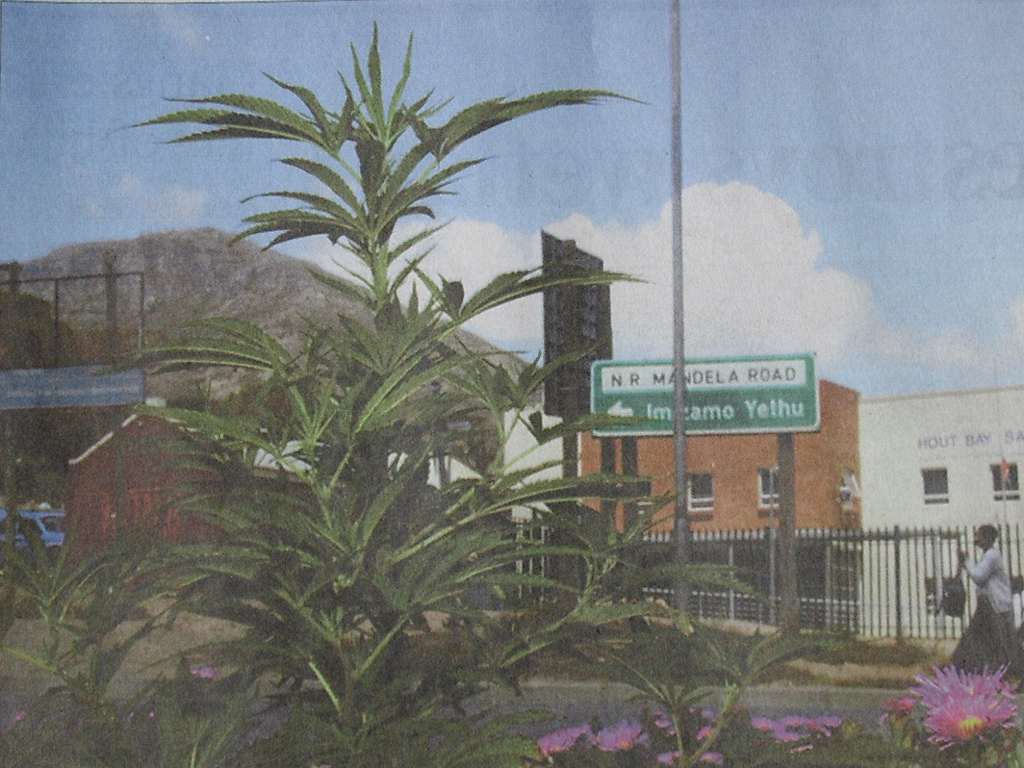
Hout Bay residents may be forgiven for believing the government has finally heeded calls to legalise dagga.

A flower bed in the middle of a traffic circle, in front of the Hout Bay police station, has provided fertile soil for a couple of marijuana plants that have mysteriously cropped up among the blooming vygies.

The dagga doesn't seem to be too high on the city council's agenda either, as workers continue to water them without noticing.

The plants were discovered by a landscaper, Tim Lundy, while working on the flower bed last week.

"Being a landscaper, I see these growing all over the place. You won't believe how many people grow it. A person must have been smoking weed and thrown down his stompie (in the flower bed). It's a few metres from the police station. And the council also happens to water the island."

Hout Bay police station commander Dirk Smit wouldn't believe it when told about the plants, and insisted the Cape Times was "pulling a prank" on him.

The interview didn't end on a high note. He hung up. Cape Times


Monday, October 30, 2006

SWAZILAND: Illegal cannabis could become legal 'Swazi Gold'

(IRIN) - A fundamental shift in Swaziland's attitude towards the cannabis plant, or hemp, the country's most lucrative cash crop, could be on the horizon. The government is set to allow small-scale production of hemp to see if it has the potential to become an economically viable crop.

"In hemp we have an alternative to cotton, which has let us down badly over the last few years. It has been because of marijuana that we have found it difficult to talk about hemp, but that is changing, and we are beginning to shape public opinion to its benefits," said Lufto Dlamini, the Swazi Minister for Enterprise and Employment.

"The government is considering a proposal to grow hemp, and a decision will be reached by the end of this month. But I expect it will be given the go-ahead to grow for research purposes, and if that proves successful then we will see," he told IRIN.

Falling global prices for sugar and cotton, Swaziland's traditional crops, have led to cannabis, or 'dagga' as it is known locally, becoming 'Swazi Gold' for many of the country's impoverished population, most of whom live on less than US$1 a day.

According to the government's Annual Vulnerability Monitoring Report 2005, cotton prices have fallen steadily over the past few years as a result of international competition and last year's price for cotton was about 33 percent lower than the previous year.

A similar fate has befallen the sugar industry. The European Union plans to slash its price to suppliers in African, Caribbean and Pacific Least Developing Countries by 37 percent from the start of 2007 to bring it in line with the global price, causing the profits of Swazi producers to shrink significantly.

The ongoing decline of these major contributors to the agriculture sector, which is faltering as a whole, have led to widespread job losses and left many Swazis with no means of putting food on the table other than subsistence farming, including cannabis growing.

Swaziland's climate and soil are conducive to growing cannabis and the plant has been grown for many centuries, either for export or for use locally as a stimulant.

In the past four years an increasing number of entrepreneurs have suggested that the large-scale production of hemp would go a long way to counteracting poverty.

Dr Ben Dlamini, 70, a former education administrator in the Swazi Department of Education, was one of the first people to talk about the potential benefits of hemp production.

"The major emphasis on cannabis in Swaziland has always been on smoking it and getting a 'high', but if we were to grow hemp commercially it would solve a lot of problems. It can be used to manufacture fuels, textiles, healthy oils and lotions," he pointed out.

"People are getting the idea that hemp can be used for purposes other than smoking, but the process of understanding this is very slow."

Simon Mavimbela, 21, and Justice Dlamini, 26, have lived all their lives in Hhohho, in the north of the country, the main area for cultivating cannabis, where many people risk growing the illegal plant rather than other cash crops like maize or peanuts.

While both young men insisted that they did not grow cannabis themselves, they admitted that friends and members of their families had grown the plant for generations.

"People here will get around R80 [about US$11] for a 10kg bag of maize when they sell it at the market, but they will get R3,000 [about $405] for a 10kg bag of cannabis if they can sell it to someone who is going to take it outside of Swaziland," Dlamini explained.

"A person can grow 30 10kg bags in a year up in the hills here, and they use the money to buy cows, furniture, send their children to school. We are in a good situation because our fathers grew dagga, so we could afford to go to school, have clothes and other benefits."

According to Dlamini, the only difference between growing cannabis and any other crop is that they have to avoid detection by the police by locating the plantations in inaccessible areas.

"If they are lucky, people from South Africa come and give them the money to start up, and then come back and buy the cannabis after it has been harvested. They then take the stuff through holes in the boarder fence into South Africa. You have to be very careful, though, because the police are always around - people do all their crop-work early in the mornings, so that the police will not see what they are up to."

In 2005 the United Nations Office on Drugs and Crime estimated that the global illegal trade in cannabis was worth $142bn and listed Swaziland as one of the major producers in southern and eastern Africa. IRIN NEWS

SWAZILAND: Fighting a losing battle against cannabis growers

(IRIN) - You can smell the plant's sweet, peppery scent as it wafts through the Swazi bush in the mid-morning heat long before you see it.

After a 5km trek through the rugged terrain and tangled foliage that covers much of the country's northern Hhohho region, the unit of 30 police officers finally scrambled into a clearing.

Standing over six feet tall, row upon row of what they were looking for stretched out before them: hundreds of cannabis plants, also known as 'dagga' in this region, with the tools of the trade - shovels, plastic sheets and watering cans - scattered around its fringes; the growers were nowhere to be seen.

While it appeared to be a large find, the head of Swaziland's anti-drug unit, Supt Albert Mkhatshwa, who accompanied the search-and-destroy operation, maintained that such plantations were nothing out of the ordinary.

"This is just dagga being grown by some of the villagers close by. We will spray it with weed killer and the plants will be dead in a day or so, but if we come back in a month's time it is likely more will be growing in the same spot.

"The people know we don't have the necessary resources to cover the whole area, so they will take a chance that we will not come back soon. People have been growing herbal cannabis for a long time in Swaziland, long before it was illegal," he said.

Swaziland's climate and soil are conducive to growing the plant, and the people have known and used it for hundreds of years. However, over the last decade the combination of international demand and extreme poverty - about 70 percent of the country's one million people live on US$2 or less a day - has led to widespread cultivation.

The crop is grown in such large quantities that the United Nations Drug Control Programme has listed the country, which covers only 17,363sq.km, as one of the main cannabis-growing areas in southern Africa. The latest Interpol statistics estimate that east and southern Africa supplied 9 percent of the global $142 billion cannabis trade in 2004, with the region's major producers being identified as Lesotho, Malawi, South Africa, Swaziland and Tanzania.

'Swazi Gold' cannabis is internationally known for its potency - users experience a mild hallucinogenic affect when they ingest or smoke it - and consequently it is a highly sought after commodity in neighbouring South Africa as well as Europe.

An almost insatiable worldwide demand for the substance has attracted international crime syndicates to the country to fund and organise the large-scale production of dagga by locals.

According to South Africa's Institute for Security Studies (ISS), a regional think-tank, the financial proceeds are then used to fund other illegal activities.

"Of the cannabis that is harvested, the best quality is earmarked for compression into one- or two-kilogram blocks that are smuggled via South Africa and Mozambique to Europe and the UK [United Kingdom]," said a recent ISS report on Swaziland's cannabis trade.

"Nigerian criminal networks have moved into the dominant position in the Swazi cannabis trade during the past few years, and the proceeds of their sales in Europe are used to pay for cocaine purchased in South America, which is then smuggled to South Africa and elsewhere."

After consulting police experts in Swaziland and the European Union (EU), the ISS revealed that growers at the point of sale in Swaziland received between $45 and $52 per kilogram, depending on quality. However, once the narcotic has reached the EU's streets its retail value is about 140 times that amount, with high-quality Swazi Gold fetching as much as US$7,600 a kilogram in the UK.

So far, the limited success of the Swazi police in controlling the illegal trade has coincided with locating the plants before they were harvested. Once compressed and packaged, consignments are taken into neighbouring countries using back roads, or simply through holes cut in the border fence, which are "notoriously difficult to monitor," said Supt Mkhatshwa.

The successes in the field were largely due to assistance given by the South African and United States governments, both of which provided specialised equipment, such as helicopters and off-road vehicles, to help the anti-drug units locate plantations grown in areas not easily accessible by road.

South Africa recently withdrew its assistance, leaving the Swazi police to tackle the problem with the meagre resources at their disposal.

South African Police spokesperson Ronan Naidoo said the South African government had assisted the Swazi police with aerial surveys and crop spraying aircraft in the past, but co-operation on operations was no longer in place because of escalating costs. "There have been many joint operations, but they have to involve a joint covering of the expenses involved for them to continue," he told IRIN.

Swaziland, ruled by King Mswati III, sub-Sahara's last absolute monarch, saw its economy contract from 2.1 percent growth, last year to 1.8 percent this year, while the population increased by 2.9 percent, the central bank said in a report to the government this month.

Consequently, Supt Mkhatshwa now dispatches his anti-drug units into dense bush and mountainous areas on foot, with nothing more than a container of weed killer on their backs and a spray gun in their hands.

"I send men into the bush to survey the areas for the dagga plantations and once they find a sizable crop a larger group goes back and sprays the area. We are doing this every two weeks, but it is not having much impact.

"A couple of years ago the South Africans did aerial surveys for us over the inaccessible regions, and when they found plantations they either sprayed them from the air or flew us in to spray them. This co-operation enabled us to rid ourselves of large amounts of dagga growing in areas that take a full day to get to by foot," he said.

The latest statistics compiled by the Swazi anti-drug unit show that in the first seven months of this year 2,407kg of compressed cannabis was seized, and a further 356.5ha of cannabis plantations were destroyed.

"If we were able to do real surveys we would be able to destroy lots more than we have done. It is so difficult to reach the plantations in the mountainous areas. Often times they are so large that we are not able to carry enough chemicals to spray all the plants. Unless we get help, this [problem] will become extremely difficult to control," he said.

IRIN NEWS

Friday, October 27, 2006

Stranded and stoned:

Tens of thousands of Capetonians were left stranded, buses were stoned and at least three commuters injured as protests by taxi drivers entered a second day on Friday.

There was widespread stoning of Golden Arrow buses as residents of Khayelitsha, Crossroads and Nyanga queued for hours - often in vain - for alternative transport into the city, Bellville and east towards Somerset West.

A large police contingent descended on the suburbs and arterial routes shortly before dawn, but the stoning continued. Cape Argus

Tuesday, October 24, 2006

Habitat Research

“Research makes no difference to the human habitat environment unless it is translated into policy, practice, promotion and products,”

70 Actionable Ideas - World Urban Forum

Thursday, October 19, 2006

Fishhoek blaze leaves 300 families homeless

More than 300 families were left homeless on Thursday after fires ravaged an informal settlement in Fishhoek, Cape Town local disaster management said.

Spokesperso Craig Pillay said fire-fighters responded to a reported fire at Masiphulele township at about 2am.

"The fire department responded in 10 minutes and managed to put blazes under control."

No injuries were reported and the cause of the fire was unknown.

"We have contacted NGOs to assist the victims. The Red Cross would provide blankets and the Salvation Army would provide warm meals," Pillay said.

He said the city council would provide shelter to the affected families. - Sapa

Tuesday, October 17, 2006

AfriCAN HOUSEIT - Cape Town's - Shack Towns

Google Earth view of Cape Town's informal settlements

View the web based option from here: Google Maps Shacks

Open this Placemark

If you have Google Earth installed.

Download Google Earth free here: http://earth.google.com/

(Please note this program is not suited for older computers)

Monday, October 16, 2006

Cape fires kill, leave hundreds homeless

A three-year-old girl died and more than 130 people were left homeless after fires ravaged two informal settlements in the Western Cape on Saturday and Sunday, the SABC reported.

On Saturday, the child was killed and more than 60 people were left homeless after 15 shacks were destroyed in Wallacedene, near Kraaifontein.

On Sunday, the SABC reported that a second fire had surged through Joe Slovo Park, near Milnerton, leaving more than 70 residents of 29 dwellings homeless but unhurt.

Cape Town disaster management spokesperson Wilfred Solomon said that the cause of the fires was not known.

He said they were providing the necessary relief, accommodation, blankets and food as well as building materials to both communities. - Sapa

Monday, September 18, 2006

Fire leaves scores homeless in Khayelitsha

About 75 people have been left homeless after a fire razed their shacks in Khayelitsha on the Cape Flats early this morning.

A spokesperson for Fire and Rescue says more than 28 shacks were destroyed. No deaths or injuries have been reported. The cause of the fire is being investigated. SABC

Monday, September 11, 2006

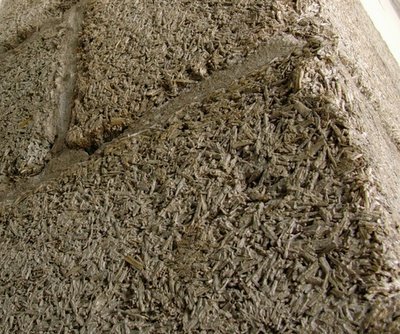
New links to Cannabis brick demonstrations


Please see the links on the left to MMM 2003 -2005: A new page will open for each link.

Details for cannabrick construction can be found here on Houseit or at InternAfrica

Saturday, September 09, 2006

Boy dabbling with dagga, sentenced to gang rape

A FEW days later, Wimpie, a white boy who was dabbling with dagga, is put in our cell. I don’t know how old he really is, perhaps 16 or more, but he looks no older than 14, with skinny arms and short, spiky-crowned, brown hair.

The 28 gang give him a chocolate bar in the morning and it’s obvious what his eating of it preludes. Still, it is strange how even the minds of paedophilic rapists seem to demand some sort of mechanism by which they can excuse their crimes. They’ve given him a chocolate bar and they are going to enjoy having him repay the kindness.

It isn’t meant for Wimpie to be spending the evening in a cell full of libido-possessed 28s, but the warders took care of that. They know what to do to keep the prisoners happy.

The night it happens, I am in a cell with 80 men. What I am about to witness will make ridiculous the notion that someone can be safer in a crowd.

Three-quarters of the men do not want to be part of this, or they are excluded. The other 20, they know one another, and begin the sick game with the boy. He is cocky and tells them to leave him alone.

“What are you doing?”

He tries to fight, and so they hit him. His resistance stops abruptly when one grabs the back of his head and smashes his face into the steel bars ...

The boy has been in prison for weeks now, but this is his first moment of true captivity.

The 20 take it in turns to rape him. It goes on for more than eight hours, almost the whole night. The boy does everything he can, in his pathetic, limited range of action, to try to deter them, but he is ignored. He screams, he cries, he begs, he tries to bargain, he prays.

He is ignored ... Bück dich (Bend Over)

It is in the morning, though, that I am forced to see what life has coughed up before me. What’s left of Wimpie is lying in a corridor between the bunks, just in front of my bed. He is still naked, shivering in a pool of his own blood where they have discarded him. I will literally have to step over the small body to go and eat my breakfast. I am about to do just that, too, when I look him in the eyes.

All of the racist hate and hardness of my heart seems cheap. Is it important where a victim is born, where he went to school, whether or not his ethnicity gave him advantages denied others, or whether or not he is white or black?

In suffering, we are all the same.

How can I step over this cosmically battered body, and sit down to breakfast? How can anyone?

Right there, in that dismal space, with other men’s clothing strewn about on rusting beds, beside bars with psoriatic, peeling paint, I am alone with this boy’s pain.

I no longer know how I can continue to live. I have no more answers, and I am tired of all the old questions too.

The Gayton McKenzie Story Sunday times : Redemption
InternAfrica is a not-for-profit organisation addressing the Cape Habitat Crisis through education of sustainable green building methods as demonstrated here on HouseIT