This year's National Arbour Week will be celebrated under the theme "Plant a tree, grow our future". The week starts today and will end on September 7. In Limpopo, various events will be held in all the municipalities.
The main focus of the week is to highlight opportunities for sustainable economic development, community participation, poverty alleviation and job creation in forestry. It is also to focus on the vital role trees play in the natural environment and to encourage the youth to participate in tree-planting activities. - SABC
More than double the amount collected in liquor taxes is spent on the social costs of alcohol-related trauma and accidents in South Africa each year.
With this in mind, a government and industry initiative - aimed at reducing the socio-economic impact of alcohol by ensuring legal compliance by traders and responsible drinking by consumers - was announced on Monday... - Pretoria News
This lion was reared by the guys in the clip,he was then released into the wild in Africa but a year later the guys returned to see if he was doing OK.
Check out the look on the lions face as he realises-"thats not food its my MATES!!" The wild lion he is friends with, has never met the humans and is totally passive towards them.
Five prison warders were dismissed from their jobs for refusing to cut off their Rastafarian dreadlocks, their union said Friday.
The five, employed at the Pollsmoor prison outside Cape Town, were disciplined for contravening the Department of Correctional Services' dress code, said Police and Prisons Civil Rights Union spokesperson Benzi Soko.
"The dress code cannot supersede the constitution, which guarantees freedom of religion," said Soko, adding the matter would be pursued to the highest level necessary.
"Our lawyers are preparing an urgent application to the Cape High Court for the members' immediate reinstatement."
He said the five were barred from the workplace, but were receiving their full salaries pending the outcome of an internal appeal process.
The department confirmed the dismissals, saying the five "defiantly ignored warnings to comply" with its dress code.
"The department of correctional cervices fully respects the legal rights of every official but cannot compromise discipline nor appreciate the flouting of its policies and regulations," it said in a statement. - Sapa-AFP
For the homeless on Fort Wynyard Road, the by-law is a puzzle: "I want to ask them why they don't take the rubbish away but they take us away," says Rasta. - Cape Argus
Police say, In the 2005/2006 financial year 290 000kg of dagga valued at R377-million was seized throughout South Africa while police, through their cannabis eradication programme, destroyed 170.5ha of dagga plantations valued at R119-million in the Eastern Cape alone.
I would say - someone can't add... that looks like the appelton case below and not total figures, once again I would have to question these figures - which continuously seem to amaze me. How this can be called a success when each year the figure is higher - - - all that is clear to me - is the current way of dealing with drugs is flawed and destined to fail in preventing social harm.
A fire destroyed shacks at an informal settlement in Mamelodi near Pretoria on Friday, police said.
Police spokesperson Paul Ramaloko said the cause of the fire was not known, but it started after residents at the Lusaka informal settlement in Mamelodi East attacked security personnel who had arrived to evict them.
He said one of the security officers was stoned to death and a truck was also burnt.
He said people refused to move and a confrontation ensued between them and the security officers.
"They threw stones at security guards and one security officers was stoned to death.
"A truck that was to load their belonging was also set on fire," he said.
A strong police contingent had been sent to monitor the situation, he said. - Sapa
The union representing the majority of South Africa's police called on Thursday for a review of the laws against dagga and sex work.
In resolutions approved on the final day of its national congress in Cape Town, the Police and Prisons Civil Rights Union (Popcru) declared that both areas should be "regulated".
One delegate even urged that if sex work was legalised it should be turned into a public-private partnership rather than be left to the vagaries of free enterprise.
The resolutions, both proposed by Popcru's Gauteng region, follow a suggestion earlier this year by National Police Commissioner Jackie Selebi that prostitution be legalised for the 2010 soccer world cup.
The resolution on dagga noted that use of the drug was regulated in other parts of the world, such as Holland's Amsterdam.
It called for research on "the prospective aspects of dagga regulations" and on the drug's medical effects, and committed the union to work towards steps "to counter the stigma".
The union will also "pursue discussions with authorities on dagga regulations".
One delegate, Durban police officer Christopher Mkhize, told the congress that dagga had been around in South Africa long before white settlers arrived and decided it was wrong.
"We can't stay with that in a democratic country," he said. "It is our democracy and we are the ones who should say what is wrong and what is right."
He said he himself would not have achieved his current qualifications if it were not for the money raised by his family's cultivation of dagga in rural KwaZulu-Natal.
"Most of our kids have been taught through money generated by dagga," he said.
The resolution on sex work - described in the original motion as "prostitution" but changed after objection from a female delegate - called for "street transactions" to be made illegal, which they already are, and for a working environment which complied with labour legislation.
Giving his interpretation of the dagga resolution, union president Zizamele Cebekhulu told Sapa afterwards that the union was calling for research "that confirms the danger of dagga to a human being".
He said the drug contributed a certain percentage to South Africa's gross domestic product whether one liked it or not.
"Some parents are still smoking dagga in their house. It's outlawed, but they smoke it. So we say, regulate this thing, tax this thing, and... let dealers not go away with the money."
He insisted that regulation of the drug would mean a harsher regime than the current ban on dagga.
"It's useless to say it's illegal, and yet you have got no control measures over it.
"We say, regulate it, meaning that you put more stricter measures in terms of dealing and in terms of consuming dagga." - Sapa
More than R200-million spent on an irrigation project in Limpopo appears to have gone to waste, SABC television news reported on Friday.
The availability of water and electricity were not considered during the programme's initial planning and there was no water available in its installation area, according to the Friday night report.
Some of the R100-million worth of irrigation equipment had been vandalised. - Sapa
"I'm not going to pretend that my drug of choice is not marijuana, because it is," he said.
"We could sit here with any number of policemen and doctors and they would all tell you if everybody who had a dependence on alcohol changed their mind and had a dependence on weed, the world would be a much easier place to live in.
"What I am saying is that nobody ever came home stoned and beat up their wife."
The singer plays a second straight night on Saturday in Aarhus, Denmark, on his 25 Live European tour that will see him become the first artist to play the new 90 000-seater Wembley Stadium in London, something he described as a "dream come true."
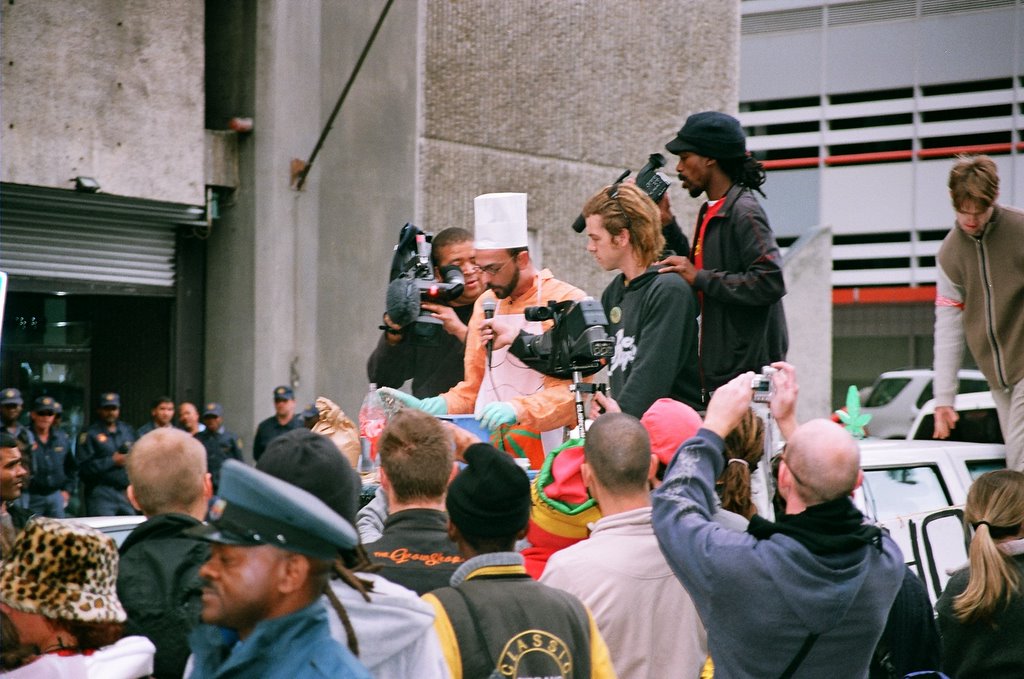
Standing outside a warehouse, Scorpions head Leonard McCarthy held up a shrink-wrapped, one-kilogramme brick of dagga and smiled for the cameras.
Behind him, workers inside the building were pushing four tons of the drug into a furnace to be incinerated - about 3 900 bricks with an estimated street value of R364-million, had the bricks reached their destination in England.
"It's a feel-good occasion," McCarthy said. "Scorpions in the Western Cape have punched a hole in organised crime."
The burning put a ceremonial cap on Operation Appleton. In July, the investigation led to the largest seizure of contraband in the Western Cape yet.
It was also the largest success yet in Project Red Cross, the Scorpions' two-year-old initiative targeting South Africa's drug syndicates.
Members of the National Prosecuting Authority (NPA) will not discuss the specifics of the programme for fear of tipping off criminals about their methods.
The project has its sights on international traffickers and importers and exporters who deal in the largest and most valuable drug loads and who have made South Africa a hotspot in the global drug trade.
The Scorpions had not gained extra manpower or funding for the effort, but officers were using resources more strategically, said NPA deputy spokesman Tlali Tlali.
"We are operating on the basis of what we have," he said. "We will not fold our arms and say it's not enough."
This translated into extra emphasis on fundamentals like information analyses and following up on even the smallest leads, he said.
In the case of Project Appleton, the tip-off seemed unextraordinary at best, said Jannie Stamatiadis, a Scorpions special investigator and the project's manager.
An ordinary theft complaint spurred the investigation, largely on a hunch. The Scorpions found the dagga - a seedless variety grown in Mozambique and prized on the European market - packed into the apple containers, two days before they were to be shipped to England.
A South African and two British nationals have been arrested. The investigation continues. Cape Times
About four tons of dagga seized before it could be smuggled out of the country in apple boxes is due to go up in smoke on Wednesday.
National Prosecuting Authority (NPA) spokesperson Phumzile Kotane said on Tuesday that drugs, mostly dagga, were seized in the Scorpions' Operation Appleton in Cape Town, which foiled an international drug trade worth about R364-million.
"Operation Appleton ended in July 2006 with the arrest of two British nationals and a South African. The trio was caught in the act of concealing tons of drugs in boxes of apples which were being exported," said Kotane.
"A warehouse used to store more drugs was later discovered by the investigators.
"It was clear that the intention was to smuggle the drugs into the United Kingdom."
The three were convicted of trafficking in drugs and given sentences ranging from five to 12 years and fines.
NPA spokesperson Tlali Tlali said the drugs could not be destroyed until the court case and any appeals were over.
"You don't interfere with exhibits of evidence until the trial is concluded."
The drugs are due to be burnt in the Western Cape on Wednesday afternoon. - Sapa
A haul of home-made guns, knives, cellphones and drugs, including tik, have been found at a municipal tip near Muizenberg - all of it believed to be evidence dumped by police.
There were at least 30 knives, homemade BB-type guns and drugs, including dagga, Mandrax and scores of tik straws and lollies.
The stash also included a large number of ampoules containing a local anaesthetic called Xylotox.
Attached to some of the items were police case numbers from last year and, on one official forensic laboratory bag, the name of a Mitchell's Plain constable. Cape Argus
Plant a cannabis seed. Water and allow the plant to grow and produce seed. Plant and water these seeds. Your goal is to grow enough to build a house, you will need about 1 acre to build a 5 roomed home.
Start planning where your house will stand. Consider everything about the environment you’ll be building in, like winter and summer sunshine, wind and rain – you don’t want to build on a floodplain, or your house will wash away. Be sure to plan all your water and waste requirements.
Cut the grown cannabis plants down and leave in the field to rhett for a week. The morning dew and natural rotting process will loosen the fibers from the plant.
a. Process the plant matter by cutting leaves and branches off, then hit small bundles the length of the plant over and upturned rake. b. The long fiber parts that remain in your hand are good for weaving rugs and making various other items your skills can accomplish. c. The seed can be gathered for more housing. d. Gather the small woody bits (the hurd) that have fallen, this waste is what will be used in the construction material.
a. Yikhawulezise ngohlukanisa intonga zezityalo namagqabi, uhlale uyiharika rhoqo. b. Intonga ezi zinothi zincede kwezinye izinto ezifana nokwenza ingubo nezinye izinto onothi uzibonele zona ngokolwazi lwakho. c. Imbewu inokuqokelelwe ukwakha ezinye izindlu. d. Qokelela imithana ethe yaziwela njengokuba uzoyisebenzisa xa usakha indlu yakho.
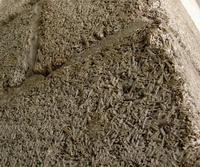
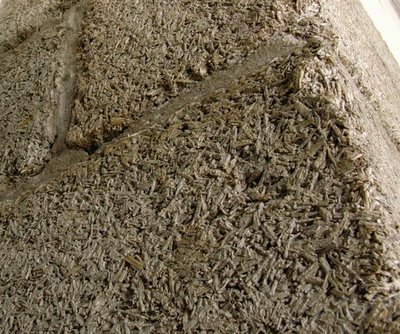
Wash the hurd, dry it, then wash it again. Be careful not to allow the matter to rot or decay during this process, by turning, airing and allowing the African sun to dry the hurd properly. Now combine in proportions 10:2:3:3 combine the cannabis/ntsangu/dagga Hurd(10), washed river sand 0.5mm(2), hydraulic lime(3) and water(3) to make the mulch (This process may need tweaking depending on your geographic location, humidity, rainfall etc)
· You can use this “dagga-cement” for making bricks, shutter casting or the proven “pole-and-dagga” method. This last method allows for a sturdy, warm, fireproof and water proof home – built with pride and intuitive engineering, not a ‘uniform box’.
Be sure to consider all aspects of your house design and structural requirements. Although the cannabis-cement will become stronger than steel in time, it is not advised to build over 2 floors high without considering structural implications. With planning this cement can be used to build up to 4 floors high.
The cannabis-cement will dry over a period of a month (depending on the weather). At this point you will be able to add the roof. Seal your home’s walls with lime; lime external walls annually.
Decorate your house with masonry to make it unique, and paint with coloured lime as per custom.
Always PLANT A TREE in a place that will provide shade, to commemorate this accomplishment.
Council will plant trees if citizens care for them. Call (021) 689-8938 http://www.trees.org.za/
Assist your family, friends or neighbors with your experience and expertise. Share information and technique; you can uplift yourself and your community.
Prostitution and drinking in public could be legalised for the duration of the 2010 Soccer World Cup, if National Police Commissioner Jackie Selebi has his way.
The police chief on Wednesday asked the National Assembly's safety and security committee to apply their minds to his dilemma of what to do with the thousands of "soccer hooligans" expected to imbibe in public spaces and those who would feel the urge to try out other more exotic pastimes both currently illegal in South Africa.
"You as a committee must be sitting and thinking of how we are going to get around this. If a visiting fan is out on the street having a bottle of beer, must I arrest him, because it is illegal?
A new commission is also due to undertake a three-year review of general government drug policy.
The new system has been developed by a team led by Professor David Nutt, from the University of Bristol, and Professor Colin Blakemore, chief executive of the Medical Research Council.
It assesses drugs on the harm they do to the individual, to society and whether or not they induce dependence.
A panel of experts were asked to rate 20 different drugs on nine individual categories, which were combined to produce an overall estimate of harm.
In order to provide familiar benchmarks, five legal drugs, including tobacco and alcohol were included in the assessment. Alcohol was rated the fifth most dangerous substance, and tobacco ninth.
Heroin was rated as the most dangerous drug, followed by cocaine and barbiturates. Ecstasy, however, rated only 18th, while cannabis was 11th.
The researchers said the current ABC system was too arbitrary, and failed to give specific information about the relative risks of each drug.
It also gave too much importance to unusual reactions, which would only affect a tiny number of users.
Professor Nutt said people were not deterred by scare messages, which simply served to undermine trust in warnings about the danger of drugs.
He said: "The current system is not fit for purpose. Let's treat people as adults. We should have a much more considered debate how we deal with dangerous drugs."
He highlighted the fact that one person a week in the UK dies from alcohol poisoning, while less than 10 deaths a year are linked to ecstasy use.
Professor Blakemore said it was clear that current drugs' policies were not working.
"We face a huge problem. Illegal substances have never been more easily available, or more widely abused."
He said the beauty of the new system, unlike the current version, was that it could easily be updated to reflect new research.
Professor Leslie Iversen, a member of the Academy of Medical Sciences group considering drug policy, said the new system was a "landmark paper".
He said: "It is a real step towards evidence-based classification of drugs."
Professor Iversen said the fact that 500,000 young people routinely took ecstasy every weekend proved that current drug policy was in need of reform.
Home Office Minister Vernon Coaker said: "We have no intention of reviewing the drug classification system.
"Our priority is harm reduction and to achieve this we focus on enforcement, education and treatment."
He said there had been "unparalleled investment" of £7.5 billion since 1998, which had contributed to a 21% reduction in overall drug misuse in the last nine years and a fall of 20% in drug related crime since 2004.
But he added: "The government is not complacent and will continue to work with all of our partners to build on this progress."
Plans to build hundreds of thousands of new low-cost homes could fall victim to shifting budget demands in the run-up to the 2010 Soccer World Cup, South Africa’s housing minister said on Thursday.
While the government has targeted the eradication of all shack dwellings by 2014, Housing Minister Lindiwe Sisulu said there was a danger that her ministry’s demands for both cash and infrastructure “could be completely wiped off the radar screen”.
Sisulu said there was a “clear and present urgency” to secure the finance, raw materials and land needed to re-house the 2,4-million families currently living in informal settlements before the competition for resources becomes even more intense.
“This [low-cost housing for the poor] is a constitutional requirement of this government, so we want to make sure that … in the next two years we can have a massive injection in housing,” she said.
The minister said housing delivery would have to double from the current 250 000 units a year to achieve the goal of eradicating shantytowns by 2014.
A shortage of cement was only one of the obstacles, with retailers more willing to sell to private companies than the government, Sisulu said.
South Africa, with unemployment estimated as high as 40% and millions living in poverty, has budgeted R15-billion to host the first World Cup on the African continent. — AFP
Scroll down the page to find a sustianable eco-alternative to cement - why yes ITS THE CANNABRICK. 1 5th the price - readily available. Carbon trap. Green-building
Bloemfontein - A tip-off led to a constable being arrested and dagga with a street value of about R500 000 being seized from a police vehicle on Tuesday, said eastern Free State police.
Superintendent Motarafi Ntepe said the Bloemfontein dog unit was tipped off that a police vehicle was about to load and transport dagga in the Ficksburg area.
"On Tuesday, about 00:30, 10km from Ficksburg, they noticed the police bakkie travelling towards Rosendal."
Ntepe said the driver of the bakkie sped off when he realised he had been spotted.
In uniform and on duty
The bakkie was chased for about 30km until it was found parked on the premises of Rosendal police station.
The driver, who was trying to run away, was stopped and the vehicle searched.
Three bags of dagga were found on the front seat and there were another 16 bags in the back.
Ntepe said the 23-year-old constable was in full uniform and on duty when he was arrested.
Free State police commissioner Amon Mashigo said: "This kind of corrupt police official does not have a place in the South African Police Service.
"We are not going to tolerate this kind of behaviour in the police service," he said. SAPA
InternAfrica is a not-for-profit organisation addressing the Cape Habitat Crisis through education of sustainable green building methods as demonstrated here on HouseIT





 I would say that on balance, many 'illegal' drugs are less harmful than the two 'legal' drugs available